
Are Fleas Dangerous?
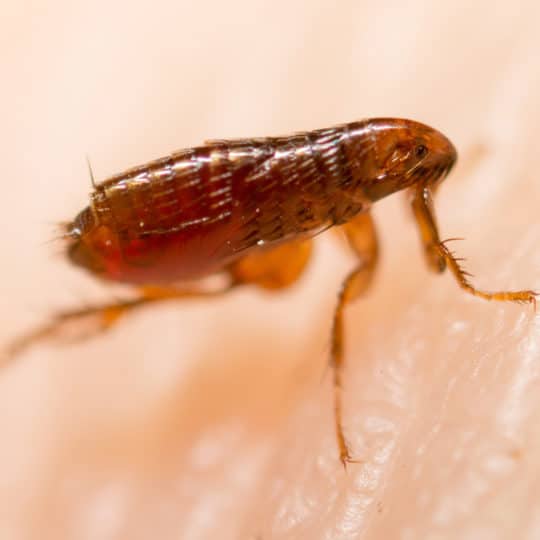
Most people think of fleas as a pet problem — an itchy nuisance that Fido brings in from the yard and that a few doses of flea treatment will clear up. That framing undersells what fleas can actually do. Fleas bite humans, transmit disease, trigger allergic reactions, and infest homes with or without pets present.
They’re worth taking seriously.
Fleas Bite Humans
The family dog or cat is usually the first to show signs of a flea problem, but fleas are not exclusively interested in animals. They bite humans regularly, and the experience is unpleasant in ways that go beyond the initial itch.
Flea bites on humans typically appear as small, red, round bumps surrounded by a lighter halo. They tend to cluster around the ankles and lower legs — the areas closest to the ground where fleas are jumping — though they can appear anywhere on the body, especially if you have fleas on a couch or bed. The itching is often intense and persistent, and scratching aggressively can break the skin and create an opening for secondary bacterial infections.
For people with flea allergies, the reaction is more significant. Hives, rashes, and widespread skin irritation can develop within 24 hours of a bite, and in some cases the allergic response requires medical attention. Children tend to react more strongly to flea bites than adults, and people without prior flea exposure often have more severe initial reactions than those who have encountered them before.
The Health Risks Beyond the Bite
The itch is the obvious problem, but fleas have a longer history of causing more serious harm. Several health risks are directly associated with flea exposure.
Fleas are capable of transmitting murine typhus, a bacterial infection that produces fever, headache, and rash and is found in areas where fleas feed on infected rodents. They can also transmit the bacteria responsible for cat scratch disease, most commonly when an infected flea deposits waste near a scratch or bite wound on the skin.
Perhaps most notably in terms of historical significance, fleas are the primary vector for bubonic plague — the same disease responsible for the Black Death. Plague still occurs in the United States in small numbers each year, concentrated in rural areas of the Southwest where infected rodent populations carry it. The risk for most suburban homeowners is extremely low, but it underscores that fleas are more than a cosmetic pest problem.
Tapeworms are another concern, particularly for households with children and pets. Dogs and cats can ingest infected fleas while grooming, introducing tapeworm into the household. Children who accidentally swallow an infected flea can also become hosts. A tapeworm infestation isn’t always obvious from symptoms alone and requires treatment once detected.
You Don’t Need Pets to Have Fleas
One of the more common misconceptions about fleas is that they only enter homes through pets. Fleas are extraordinarily mobile and resourceful, and they find their way inside through a variety of routes that have nothing to do with a family dog or cat.
Wildlife passing through the yard — squirrels, raccoons, deer, and feral cats — can leave flea eggs in the grass and soil around a property. Those eggs can survive in outdoor areas for weeks, waiting for a warm-blooded host to pass by. When that host happens to walk inside, the fleas come with them.
Homes that previously had pets — or that were occupied by previous owners who had pets — can harbor dormant flea pupae in carpet fibers, upholstery, and floor cracks for months after the animals have left. A new occupant moving into the space can trigger a flea emergence simply by introducing warmth and carbon dioxide into a dormant infestation.
Why Fleas Are Difficult to Eliminate
The flea lifecycle is what makes infestations so persistent and so difficult to eliminate without a systematic approach. Adult fleas — the ones jumping on pets and humans — represent only a small percentage of the overall flea population in an infested home. The rest are eggs, larvae, and pupae distributed throughout carpet, bedding, upholstery, and cracks in flooring.
Pupae are particularly resilient. Encased in a protective cocoon, flea pupae can remain dormant for months and are resistant to most topical treatments. They emerge as adults when conditions are right — warmth, vibration, and the presence of a host — which is why flea problems often seem to reappear days or weeks after a homeowner believes the infestation has been resolved.
Effective flea control requires treating both the adult population and the environmental reservoir — the eggs, larvae, and pupae distributed throughout the home and yard. Treating pets without treating the environment produces temporary relief at best.
Getting Rid of Fleas for Good
A flea infestation that has established itself inside a home is not reliably eliminated by over-the-counter products alone. The combination of a dispersed egg and larval population, resilient pupae, and the rapid reproductive rate of adult fleas means that incomplete treatment leaves enough of the population intact to rebuild within weeks.
Professional flea treatment addresses the infestation systematically — targeting adults, disrupting the lifecycle of eggs and larvae, and treating the yard and exterior areas where re-introduction is likely. ExtermPRO provides flea control throughout Northern Virginia, treating both the interior and exterior to eliminate the current infestation and reduce the conditions that support re-entry.
For ongoing protection against fleas and the wide range of other pests common to Northern Virginia homes, the Pest Protection Plan provides year-round coverage that keeps insects and critters out before an infestation has a chance to establish itself.
To schedule a free quote, call ExtermPRO at 571-620-1168 or reach out through the contact page.
Special Offer for New Customers
$50 Off Complete Pest Control Services
Hurry! Offer Expires October 15, 2026